

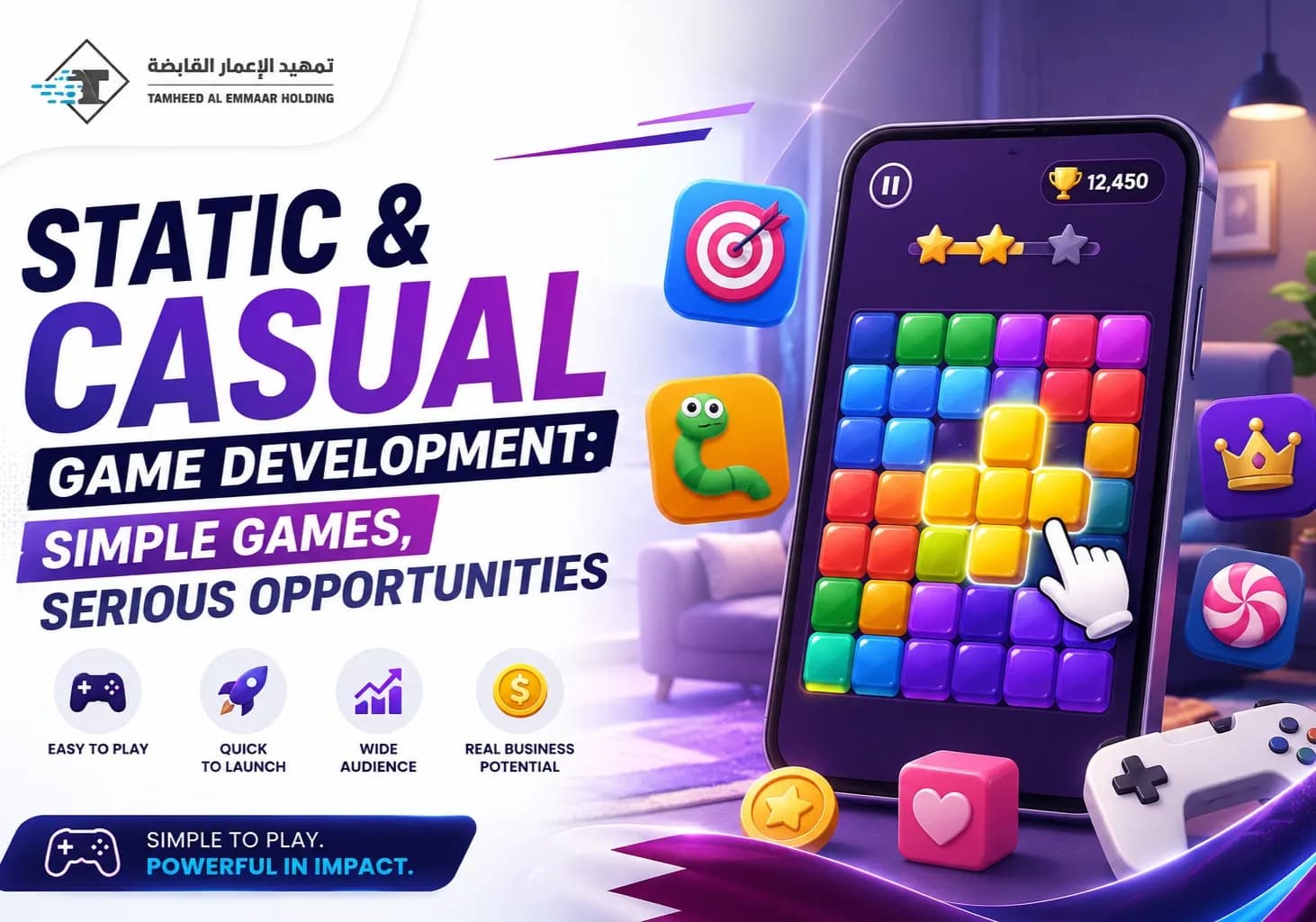
Static & Casual Game Development is becoming an attractive choice for businesses that want to enter Saudi Arabia’s growing digital entertainment market without starting with an overly complex game. Casual games are easy to understand, quick to play, and suitable for broad audiences. Static game elements can also reduce unnecessary complexity while keeping the experience visually appealing and responsive. As Saudi Arabia continues investing in gaming, technology, digital experiences, and local talent, businesses have more opportunities to create games for entertainment, marketing, education, customer engagement, and brand growth. Most importantly, a well-planned casual game can turn a simple concept into an experience players return to regularly.
What Is Static & Casual Game Development?
Static and casual games focus on accessibility. Instead of forcing players to understand complicated controls, huge maps, or lengthy storylines, these games usually let people start playing within seconds.
Casual games can include puzzles, card games, matching games, quizzes, endless runners, simple sports games, arcade experiences, board games, word games, and many other formats. Meanwhile, static elements may include fixed backgrounds, menus, boards, cards, character screens, levels, objects, or environments that do not require complex real-time simulation.
However, simple gameplay does not mean simple development.
A successful casual game still needs polished UI design, balanced progression, responsive controls, attractive visuals, reliable performance, and thoughtful monetization. Developers must also consider how quickly users understand the game and whether they have a reason to return.
Therefore, Static & Casual Game Development requires a careful balance between simplicity and engagement.
Why Are Casual Games Attractive for Saudi Arabia?
Saudi Arabia has become increasingly active in gaming and interactive entertainment. At the same time, smartphone adoption and digital consumption have created a strong environment for mobile-first experiences.
Casual games fit naturally into this market because players do not always want a long gaming session. Someone may play during a break, while travelling, or simply for a few minutes at home.
As a result, businesses can target audiences beyond traditional gamers.
A casual title may appeal to teenagers, adults, families, students, professionals, or people who rarely play console and PC games. Because the entry barrier is low, the potential audience can become much wider.
For businesses working with a game development company Saudi Arabia, this accessibility can make casual games a practical starting point.
Static & Casual Game Development for Mobile-First Players
Mobile devices are one of the most natural platforms for casual games. Players can download a title and begin playing almost immediately. Therefore, developers should design the entire experience around speed and convenience.
First, controls need to feel natural on a touchscreen. Taps, swipes, dragging, and simple gestures often work better than complex control layouts.
Second, loading times should remain short. Casual players can lose interest quickly when a game takes too long to start.
Third, developers need to consider different screen sizes and device capabilities. A game that performs perfectly on a flagship smartphone may struggle on an older device. Consequently, optimization needs to begin early rather than becoming a final-stage task.
A capable mobile game development company Saudi Arabia can design around these requirements while keeping the core gameplay lightweight and enjoyable.
What Types of Casual Games Can Businesses Develop?
Casual gaming covers a surprisingly large range of concepts. The right format depends on the target audience, business goal, monetization strategy, and desired level of engagement.
Puzzle and Matching Games
Puzzle games remain popular because the basic objective can usually be understood immediately. Matching colors, arranging objects, solving patterns, or completing short challenges creates quick satisfaction.
In addition, difficulty can increase gradually. This allows beginners to enjoy the first levels while experienced players continue receiving more challenging content.
Endless Runner Games
Endless runners use straightforward mechanics. Players may run, jump, dodge obstacles, collect items, and chase higher scores.
Because sessions are short, players can easily restart after losing. Therefore, the gameplay naturally encourages repeated attempts.
Quiz and Trivia Games
Trivia games can combine entertainment with education. Businesses, schools, tourism organizations, events, and public campaigns can use quizzes to make information more interactive.
Moreover, localization makes these games particularly interesting for regional audiences.
Card and Board Games
Digital versions of familiar board and card concepts can attract users because the learning curve is usually low. Multiplayer functionality can also add social competition without making the core mechanics overly complicated.
Arcade Games
Arcade-style experiences focus on quick reactions and immediate feedback. As a result, they work particularly well when businesses want short sessions and replayable gameplay.
Why Simplicity Can Improve Player Retention
Getting someone to install a game is only the first challenge. Keeping that person interested is much harder.
This is where Static & Casual Game Development can offer an advantage.
Casual games usually reduce the time between opening the app and experiencing something enjoyable. Instead of lengthy tutorials, players can learn through interaction.
For example, the first level might teach one simple action. The next introduces another mechanic. After several minutes, the player understands the game without reading a long instruction screen.
However, simplicity alone will not create retention.
Players still need progression. Developers can add daily rewards, unlockable levels, new challenges, achievements, cosmetic items, missions, leaderboards, or seasonal events. Each feature should give players a small reason to return.
Therefore, good casual development is less about adding hundreds of systems and more about choosing the right systems.
Building a Strong Casual Game Loop
Every successful casual game needs a clear gameplay loop.
A player performs an action, receives feedback, earns a reward, progresses, and gets another reason to continue. Although that structure sounds straightforward, small design decisions can dramatically affect engagement.
Suppose a player completes a puzzle.
The game could simply load the next puzzle. Alternatively, it could show the player's score, award coins, reveal progress toward a new character, and offer a bonus challenge.
The second approach creates several small moments of satisfaction.
However, developers should avoid overwhelming players with constant pop-ups and rewards. Instead, progression should feel natural.
During Static & Casual Game Development, teams can test different reward intervals, difficulty curves, level lengths, and progression systems to identify what keeps the experience enjoyable.
UI and UX Matter More Than Many Businesses Expect
Casual games depend heavily on usability.
Players should understand where to tap without thinking about it. Buttons need appropriate sizes. Important information should remain visible. Menus should stay simple, while animations should communicate actions clearly.
For instance, collecting a reward should feel satisfying. A small animation, sound effect, and responsive visual change can make a simple action feel meaningful.
Likewise, failure screens should encourage another attempt rather than frustrate players.
A mobile app development company Saudi Arabia with strong UI and UX capabilities can help businesses create interfaces that remain clear across different mobile devices.
Accessibility also deserves attention. Readable text, understandable icons, clear contrast, adjustable sound, and intuitive navigation can make the experience comfortable for more users.
Arabic Localization for Saudi Players
Localization goes beyond translating English text into Arabic.
Developers should consider right-to-left interfaces, typography, menu layouts, cultural references, character presentation, voice content, and visual communication. Therefore, Arabic localization needs to become part of design planning rather than an afterthought.
A button layout that works perfectly in English may require adjustment when Arabic text is added. Similarly, certain jokes, references, symbols, or themes may not connect equally well with Saudi players.
Local testing can identify these issues before launch.
Moreover, developers can create Arabic-first experiences instead of treating Arabic as a secondary language option. This approach can make the game feel more relevant to its intended audience.
Monetization Options for Casual Games
Businesses usually need a clear commercial model before development begins.
Advertising is one common option. Rewarded video ads, for example, can allow players to voluntarily watch an advertisement in exchange for coins, extra lives, hints, or another benefit.
In-app purchases provide another model. Players may purchase cosmetic items, virtual currency, boosters, additional levels, or premium content.
Some games also use subscriptions, although this model generally requires enough recurring content to justify continued payment.
Meanwhile, premium casual games can charge users once for downloading the complete experience.
The best approach depends on the game concept.
Aggressive monetization can damage retention. Therefore, developers should introduce commercial elements without constantly interrupting gameplay.
Can Casual Games Use Blockchain Features?
Yes, although blockchain should serve a genuine purpose rather than becoming an unnecessary addition.
Businesses exploring blockchain game development Saudi Arabia may consider features such as digital ownership, collectible assets, interoperable items, or transparent transaction systems.
However, a casual game does not automatically need blockchain.
Adding complicated wallet setups or technical onboarding can conflict with the simplicity that makes casual games attractive. Therefore, developers should evaluate whether blockchain improves the experience before integrating it.
When blockchain features make sense, the onboarding process should remain as straightforward as possible.
This keeps technology in the background while gameplay stays at the center.
AR and VR Opportunities for Casual Experiences
Casual gameplay is not limited to traditional smartphone screens.
An AR/VR game development company Saudi Arabia can combine lightweight mechanics with immersive technologies. For example, an AR game might allow players to discover virtual objects in a physical environment. Similarly, a VR casual experience could offer short puzzles, interactive challenges, or simple simulation activities.
AR can be especially useful for events, tourism, education, retail, and promotional campaigns because users can interact with digital content inside real-world environments.
However, developers should avoid adding immersive technology purely because it looks impressive.
The technology needs to improve the experience.
If a simple touchscreen mechanic achieves the business objective more effectively, developers should choose that approach instead.
Static & Casual Game Development Process
Although casual games may appear simple, professional development still follows a structured process.
1. Concept and Audience Research
First, the development team defines the game idea, audience, platform, objectives, and competitive positioning.
A children's puzzle game requires different mechanics from an arcade game designed for young adults. Therefore, audience research influences nearly every later decision.
2. Game Design
Next, designers define mechanics, rules, progression, scoring, rewards, levels, difficulty, and monetization.
At this stage, the team should keep asking one important question: why would the player want another round?
3. Prototype Development
A prototype tests the central mechanic before the team invests heavily in production.
For example, developers can build ten basic puzzle levels before producing hundreds. If testers do not enjoy those ten, the team can change the mechanic early.
Consequently, prototyping can save significant time and development costs.
4. Art and UI Production
Once the gameplay direction works, artists create characters, environments, icons, animations, menus, effects, and other visual elements.
Static assets should still feel polished. Good composition, consistent visual language, and smooth transitions can make relatively simple graphics feel professional.
5. Development and Integration
Developers then build the complete game, connect interfaces, implement progression, integrate analytics, and add backend services when required.
A game development company Saudi Arabia may also integrate advertisements, in-app purchases, leaderboards, cloud saves, authentication, or multiplayer features depending on the project.
6. Testing and Optimization
Testing covers gameplay bugs, device compatibility, loading times, crashes, UI problems, progression balance, localization, and payment systems.
Moreover, developers should test real player behavior.
Analytics may reveal that many users abandon a particular level. That information can indicate excessive difficulty or unclear instructions.
7. Launch and Updates
Development does not necessarily end when the game reaches an app store.
Teams can monitor player feedback, retention, session length, monetization, crashes, and level completion. Then, they can use that information to improve future updates.
How Long Does Casual Game Development Take?
Development time varies considerably.
A small game with basic mechanics and limited levels could take a few months. Meanwhile, a larger casual title with hundreds of levels, online accounts, multiplayer features, custom animations, monetization systems, and regular content updates may require significantly longer.
The number of platforms also affects timelines.
Developing only for Android may require less testing than launching simultaneously across Android and iOS. Likewise, multiplayer functionality adds backend development and network testing.
Therefore, businesses should avoid choosing a development schedule based only on how simple the final game appears.
A visually simple game can still contain complex systems underneath.
What Determines Casual Game Development Cost?
Several factors influence cost.
Game complexity is one of the biggest factors. A basic 2D puzzle game usually requires fewer resources than a 3D multiplayer casual game.
Art style also matters. Custom characters, animations, visual effects, and large asset libraries increase production requirements.
Other cost factors include the number of levels, backend infrastructure, localization, multiplayer systems, AI features, AR or VR functionality, blockchain integration, testing requirements, and post-launch support.
Instead of asking only, "How much does a casual game cost?" businesses should define the desired scope first.
Then, the development team can estimate the project more accurately.
Casual Games as a Business Engagement Tool
Not every game needs to generate revenue directly.
Businesses can also use casual games to support marketing, education, customer loyalty, product promotion, or employee engagement.
For example, a retail company could create a simple branded challenge where customers earn rewards. A tourism organization could develop an interactive quiz about Saudi destinations. Likewise, an educational organization could turn learning material into short challenges.
Because Static & Casual Game Development focuses on accessibility, users do not need to identify as gamers before participating.
That makes casual gaming useful beyond the traditional entertainment sector.
Connecting Games With Mobile Applications
Sometimes a casual game works best as part of a larger application.
A brand may already have a loyalty, shopping, tourism, education, or community app. Instead of launching a completely separate product, developers can integrate mini-games into the existing ecosystem.
A mobile app development company Saudi Arabia can connect gameplay with user profiles, rewards, memberships, purchases, or other application features.
For example, users could complete a daily game challenge to earn loyalty points. Those points could then be used elsewhere inside the application.
As a result, gaming becomes an engagement feature rather than a standalone product.
What Makes Static & Casual Game Development Successful?
Successful casual games usually share one important quality: they respect the player's time.
Players should quickly understand what to do. Controls should respond immediately. Progress should feel visible. Rewards should feel worthwhile, while interruptions should remain limited.
At the same time, the experience needs enough depth to prevent repetition.
Therefore, developers must continuously balance accessibility and challenge.
Strong Static & Casual Game Development combines a simple first impression with carefully designed progression underneath. Players may learn the basic mechanic in thirty seconds, yet they can continue discovering new challenges for weeks.
That balance is what turns a basic idea into a sustainable game experience.
Frequently Asked Questions
1. What is Static & Casual Game Development?
Static & Casual Game Development focuses on creating accessible games with easy-to-understand mechanics, clear interfaces, lightweight interactions, and replayable experiences. These games can include puzzles, quizzes, arcade games, card games, runners, and branded mini-games.
2. Are casual games suitable for the Saudi Arabian market?
Yes. Casual games can work well for Saudi audiences because they support short sessions, mobile-first gameplay, broad age groups, and localized experiences. Arabic interfaces and culturally relevant design can further improve their appeal.
3. Can a casual game include multiplayer features?
Yes. Developers can add leaderboards, real-time multiplayer, asynchronous challenges, friend competitions, tournaments, and cooperative mechanics. However, multiplayer systems increase technical complexity and testing requirements.
4. Can AR, VR, or blockchain technology be added to casual games?
Yes. Businesses can explore blockchain ownership features, AR interactions, or VR experiences when these technologies support the core concept. However, developers should avoid adding technology that makes a simple game unnecessarily complicated.
5. How can businesses improve casual game retention?
Businesses can improve retention through balanced difficulty, short loading times, daily rewards, fresh levels, achievements, personalized challenges, events, progression systems, and regular updates. Analytics can also reveal where players lose interest.
Turning Simple Gameplay Into Long-Term Digital Value
The biggest strength of casual gaming is not complexity. It is accessibility. A player can understand a simple mechanic within seconds, yet thoughtful progression, polished UI, rewards, localization, and regular content can keep that same player engaged much longer. For businesses entering Saudi Arabia's expanding digital entertainment landscape, Static & Casual Game Development can support entertainment products, branded experiences, education, loyalty programs, and mobile engagement without requiring every project to become a massive game. Whether a concept requires support from a mobile game development company Saudi Arabia, game development company Saudi Arabia, blockchain game development Saudi Arabia, AR/VR game development company Saudi Arabia, or mobile app development company Saudi Arabia, the right technical approach should always serve the player experience first. Tamheed Al Emmar Holding can help businesses turn those ideas into polished, localized, scalable casual gaming experiences designed around their audience and long-term goals.