
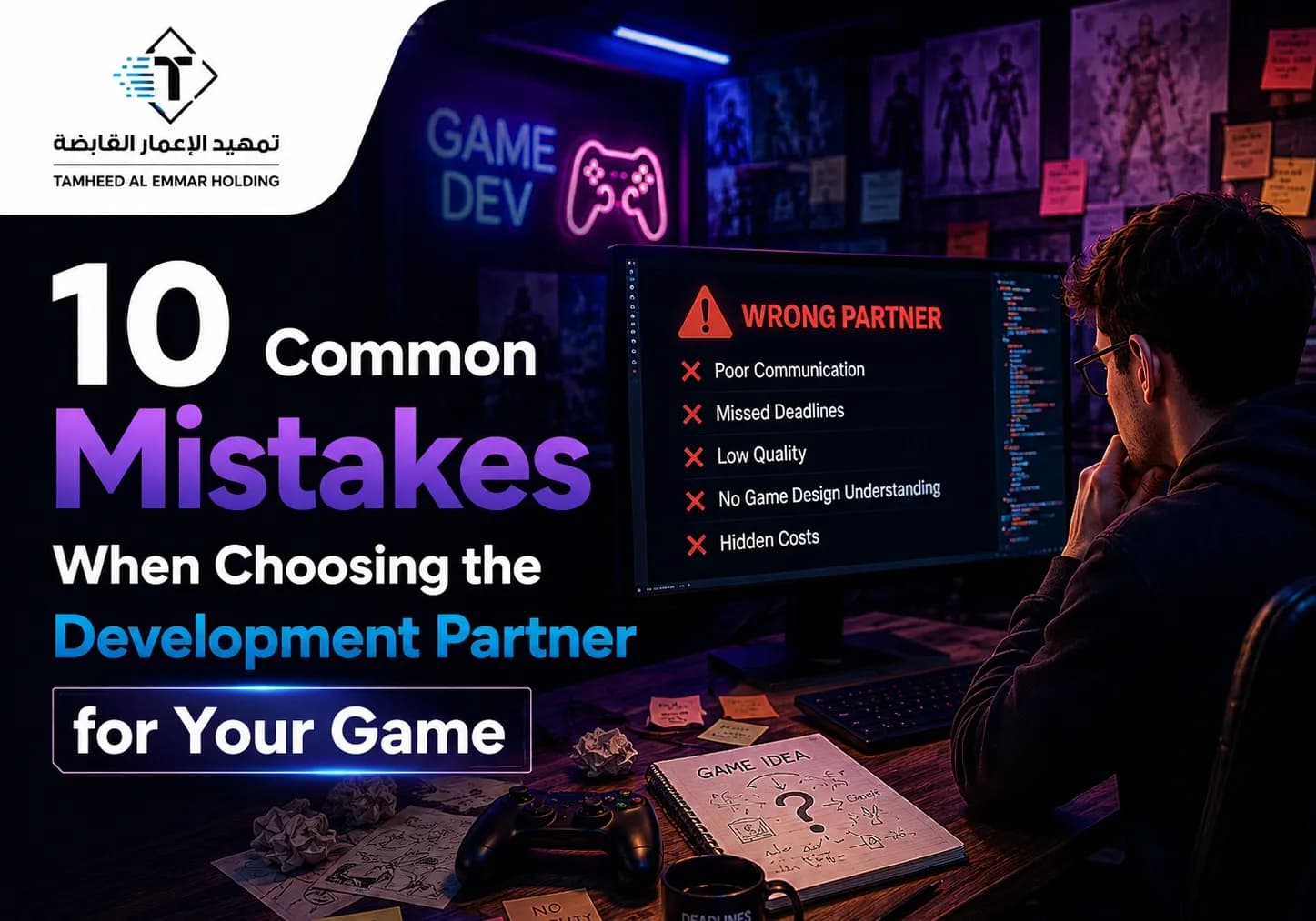
Choosing the right game development company Saudi Arabia can determine whether your game becomes a successful product or an expensive project that struggles to reach its potential. Saudi Arabia’s gaming industry is growing rapidly, creating exciting opportunities for startups, investors, publishers, and established businesses. However, selecting a development partner requires much more than comparing prices or viewing attractive portfolios. You need a team that understands your audience, technology, business model, creative direction, and long-term goals. Therefore, before signing a contract, it is important to recognize the mistakes that can lead to delays, budget problems, technical limitations, and disappointing player experiences.
Saudi Arabia has become an increasingly important gaming market as investment, digital transformation, and a young gaming audience continue to support industry growth. Consequently, businesses now have more opportunities to develop mobile games, immersive AR/VR experiences, AI-powered products, and blockchain-based gaming platforms.
However, more development options do not automatically make choosing a partner easier. In fact, the wrong decision can create problems that remain throughout the entire development lifecycle. Understanding the following ten mistakes can help you evaluate potential partners more effectively.
1. Choosing a Partner Based Only on Price
Budget matters in every game development project. Nevertheless, choosing the cheapest development team can become an expensive mistake.
A low initial quote may look attractive, especially for startups working with limited capital. However, unusually low pricing can sometimes mean fewer experienced developers, limited quality assurance, weak project management, or insufficient post-launch support. As a result, you may eventually spend more money fixing bugs, rebuilding features, or hiring another team.
Instead, evaluate value rather than price alone. Ask potential partners to explain exactly what their proposal includes. For example, determine whether the cost covers game design, development, testing, deployment, optimization, updates, and technical support.
Furthermore, compare the experience and technical capabilities behind each proposal. A reliable game development company Saudi Arabia should provide transparent estimates and clearly explain how the budget connects to project scope.
The best development partner does not necessarily offer the lowest price. Instead, it offers the right balance between quality, expertise, scalability, communication, and cost.
2. Ignoring Relevant Game Development Experience
Not every software company can build a successful game. Although general software development experience can be valuable, game development requires specialized knowledge.
Games combine programming, storytelling, visual design, animation, audio, gameplay mechanics, monetization, performance optimization, and player psychology. Therefore, you should examine whether a potential partner has experience creating games similar to your concept.
For instance, if you plan to launch a smartphone game, evaluate a mobile game development company Saudi Arabia with proven experience across relevant mobile platforms. Check whether the team understands performance optimization, touch controls, app store requirements, in-app purchases, advertisements, and mobile retention strategies.
Likewise, ask to play completed projects instead of simply looking at screenshots. This approach allows you to evaluate gameplay quality, responsiveness, interface design, and overall polish.
Relevant experience reduces unnecessary experimentation. Moreover, an experienced team can identify technical and design challenges before they become costly problems.
3. Failing to Research a Game Development Company Saudi Arabia Portfolio
A portfolio gives you important information about a development team's actual capabilities. However, many businesses review portfolios too quickly.
Do not focus only on attractive graphics. Instead, examine the complexity, diversity, and quality of completed projects. Consider whether the games offer smooth gameplay, intuitive interfaces, consistent visual styles, reliable performance, and engaging mechanics.
Additionally, investigate the company's contribution to each showcased project. Some agencies display projects where they handled only a small component. Therefore, ask what services the team actually delivered.
When evaluating a game development company Saudi Arabia, request case studies whenever possible. Strong case studies should explain the original challenge, development process, technologies used, solutions implemented, and measurable outcomes.
You should also request client references or testimonials. While testimonials alone cannot guarantee future performance, they can provide useful insight into communication, reliability, deadline management, and professionalism.
A portfolio should prove capability rather than simply create a good first impression.
4. Overlooking Communication and Project Management
Even talented developers can struggle to deliver a project when communication fails. For this reason, communication should influence your selection process from the beginning.
First, evaluate how quickly the company responds during early discussions. Next, consider whether its representatives ask detailed questions about your goals, audience, gameplay, monetization strategy, timeline, and technical requirements.
A professional game development company Saudi Arabia should also explain its project management process clearly. Ideally, you should know who your main contact will be, how frequently you will receive updates, and which tools the team will use to manage tasks.
Regular communication prevents small misunderstandings from becoming expensive problems. Moreover, milestone reviews give you opportunities to test progress and provide feedback before development moves too far ahead.
Clear reporting also creates accountability. Therefore, ask whether the partner provides sprint reports, demonstrations, testing builds, or milestone documentation.
Ultimately, strong communication keeps both sides aligned throughout production.
5. Starting Without Clearly Defined Scope and Requirements
A great idea alone is not enough to begin development. Before production starts, you need a clear understanding of what the game should include.
Unfortunately, businesses sometimes approach developers with a broad concept and expect the team to determine everything during production. This approach can create scope creep, inconsistent expectations, delays, and additional expenses.
Therefore, work with your development partner to define the project carefully. Your requirements should cover the target platforms, core gameplay loop, art style, game modes, multiplayer functionality, monetization, user interface, backend systems, analytics, security, and launch requirements.
Furthermore, prioritize features. Separate essential launch features from improvements that can arrive through future updates.
A capable game development company Saudi Arabia should help convert your concept into structured technical and creative requirements. Consequently, developers, designers, artists, and stakeholders can work toward the same objectives.
Clear scope does not eliminate every change. However, it creates a reliable foundation for controlling changes when they occur.
6. Ignoring Emerging Technology Expertise
Modern games increasingly use technologies beyond traditional game engines. Therefore, choosing a partner without considering future technical requirements can limit your product.
For example, artificial intelligence can support smarter non-player characters, adaptive gameplay, procedural systems, personalization, and operational tools. If these capabilities form an important part of your concept, collaborating with an AI development company Saudi Arabia or a game studio with strong AI expertise can offer significant advantages.
Similarly, businesses exploring digital ownership, decentralized economies, or token-based systems may need expertise in blockchain game development Saudi Arabia. However, blockchain should support the player experience rather than exist simply because the technology is popular.
Immersive gaming presents another specialized challenge. An AR/VR game development company Saudi Arabia needs knowledge of spatial interactions, device performance, motion design, comfort, 3D optimization, and immersive user experience.
Therefore, discuss your technology roadmap before selecting a partner. Even if advanced features come later, your initial architecture should support future expansion wherever practical.
7. Forgetting About Scalability and Performance
A game that performs well with 100 players may behave very differently with 100,000. Consequently, scalability should never become an afterthought.
Discuss expected player numbers with your potential development partner. If your game includes multiplayer functionality, leaderboards, cloud saves, live events, social features, or real-time interactions, backend architecture becomes particularly important.
Moreover, performance matters on the player's device. Mobile users, for instance, may have devices with significantly different hardware capabilities. Developers must therefore optimize graphics, memory consumption, loading times, network usage, and battery performance.
An experienced game development company Saudi Arabia should plan for realistic growth while avoiding unnecessary infrastructure costs during the early stages.
Ask how the team conducts load testing and performance testing. Additionally, discuss how infrastructure can expand when player numbers increase.
Players rarely care about the technical reason behind lag, crashes, or long loading screens. They simply notice a poor experience. Therefore, technical performance directly affects reviews, retention, and revenue.
8. Treating Quality Assurance as a Final Step
Testing should happen throughout development rather than during the final few days before launch.
Games contain numerous interconnected systems, which means even a seemingly minor change can create unexpected problems elsewhere. Therefore, continuous quality assurance helps teams discover issues while they remain easier and less expensive to fix.
Ask each game development company Saudi Arabia you evaluate about its QA process. A comprehensive strategy should cover functional testing, gameplay testing, compatibility testing, performance testing, usability testing, and regression testing.
Additionally, multiplayer games require network and server testing. Mobile games need testing across different operating systems, screen sizes, and hardware specifications.
Developers should also gather feedback from real players. Internal teams understand how a game is supposed to work, while new players reveal confusing controls, unclear objectives, frustrating difficulty spikes, and other usability problems.
As a result, playtesting can improve both technical stability and player engagement.
Quality assurance protects more than your launch date. It also protects your game's reputation.
9. Ignoring Post-Launch Support from a Game Development Company Saudi Arabia
Launching your game is a major milestone, but it is rarely the end of development.
After release, real users may uncover unexpected bugs or performance issues. Furthermore, operating system updates, new devices, platform requirements, and changing player expectations can require ongoing technical work.
Therefore, discuss post-launch services before signing a development agreement. A dependable game development company Saudi Arabia should explain its policies regarding bug fixes, maintenance, updates, monitoring, and new content.
You should also establish response expectations. For example, a minor visual problem may tolerate a longer response time, while a payment failure or server outage demands urgent attention.
Additionally, consider your live-operations strategy. Regular events, new levels, seasonal content, balance adjustments, and community-driven improvements can extend the life of a game considerably.
Post-launch analytics are equally important. By monitoring retention, session length, progression, purchases, and player behavior, your team can identify opportunities to improve the experience.
Consequently, long-term support should form part of your partner selection process rather than becoming an afterthought.
10. Signing a Contract Without Reviewing Ownership and Security
Contracts may feel less exciting than game mechanics or artwork. Nevertheless, they protect your business, intellectual property, investment, and future opportunities.
Before development begins, clarify who owns the source code, artwork, animations, music, characters, game design assets, databases, and other deliverables. Additionally, confirm when ownership transfers and whether any third-party components carry separate licensing restrictions.
Your agreement should also define milestones, payment terms, timelines, acceptance criteria, confidentiality obligations, change requests, termination conditions, and support responsibilities.
Security deserves equal attention. If your game collects player information or processes payments, ask how your development partner protects sensitive data.
A trustworthy game development company Saudi Arabia should answer these questions clearly rather than avoiding them.
Moreover, review how source code and project files will be stored and transferred. Proper documentation matters as well because you may eventually expand your internal team or work with additional partners.
A detailed agreement creates clarity for everyone and significantly reduces the risk of disputes later.
How to Evaluate a Game Development Company Saudi Arabia
Once you understand the common mistakes, you can create a more structured selection process.
Start by defining your business goals and target players. Then, document your essential features, preferred platforms, approximate budget, and expected launch timeline. With these foundations in place, you can compare potential partners against consistent criteria.
During initial meetings, pay attention to the questions each team asks. Strong developers rarely agree with every idea immediately. Instead, they explore the reasoning behind features and may suggest better alternatives based on technical or player-experience considerations.
Next, evaluate technical capabilities alongside creative strengths. A successful game needs both. Additionally, examine communication, QA procedures, security standards, scalability planning, and post-launch services.
If possible, begin with a discovery phase or small prototype. This approach lets you evaluate collaboration before committing to full production. Moreover, a prototype can reveal technical challenges and validate core gameplay mechanics early.
Finally, compare proposals based on overall value. The right AI game development company Saudi Arabia should function as a strategic development partner rather than simply a supplier that completes assigned tasks.
Frequently Asked Questions
1. How do I choose the right game development company in Saudi Arabia?
Start by reviewing relevant projects, technical expertise, client feedback, communication practices, QA processes, and post-launch support. Additionally, discuss your budget and timeline openly. The right partner should understand both your creative vision and commercial goals.
2. How much does game development cost in Saudi Arabia?
Costs vary significantly depending on game complexity, platforms, artwork, multiplayer systems, backend infrastructure, technology, and development time. Therefore, a simple mobile title may require a much smaller investment than an advanced multiplayer, AR/VR, AI-powered, or blockchain game.
3. Should I choose a specialized mobile game development company?
If mobile devices represent your primary platform, specialized experience can provide substantial benefits. A mobile game development company Saudi Arabia should understand mobile optimization, device compatibility, touch-based interfaces, monetization systems, app store requirements, and user retention.
4. How important is post-launch support?
Post-launch support is extremely important because games often require bug fixes, compatibility updates, performance improvements, new content, and feature enhancements. Moreover, player analytics after launch can reveal opportunities that were impossible to identify during development.
5. What should I ask a game development company before signing a contract?
Ask about development experience, technologies, timelines, milestones, communication, testing, intellectual property ownership, security, scalability, source-code access, maintenance, and post-launch support. Additionally, request a detailed proposal so you understand exactly what the quoted price includes.
Building the Right Partnership for Long-Term Game Success
Choosing a development partner requires careful research because your decision affects far more than the first version of your game. The right team influences performance, scalability, player satisfaction, development costs, security, and your ability to improve the product after launch. Therefore, avoid making your choice based solely on price, attractive visuals, or ambitious promises. Instead, examine experience, communication, technical capabilities, quality assurance, ownership terms, and long-term support. A strong game development company Saudi Arabia should understand your vision while also challenging weak assumptions and offering practical solutions that improve the final product.
Ultimately, successful games emerge from a combination of creative ideas, reliable technology, detailed planning, continuous testing, and productive collaboration. Whether your concept requires mobile development, AI, blockchain, or immersive AR/VR features, select a team that can support both today's requirements and tomorrow's opportunities. By avoiding these ten common mistakes, you can reduce development risks and build a stronger foundation for sustainable growth in Saudi Arabia's evolving gaming market. For businesses seeking a long-term technology and development relationship, Tamheed Al Emmar Holding can help turn ambitious gaming concepts into structured, scalable digital experiences.